NeuroMotion Lab
Built for Movement
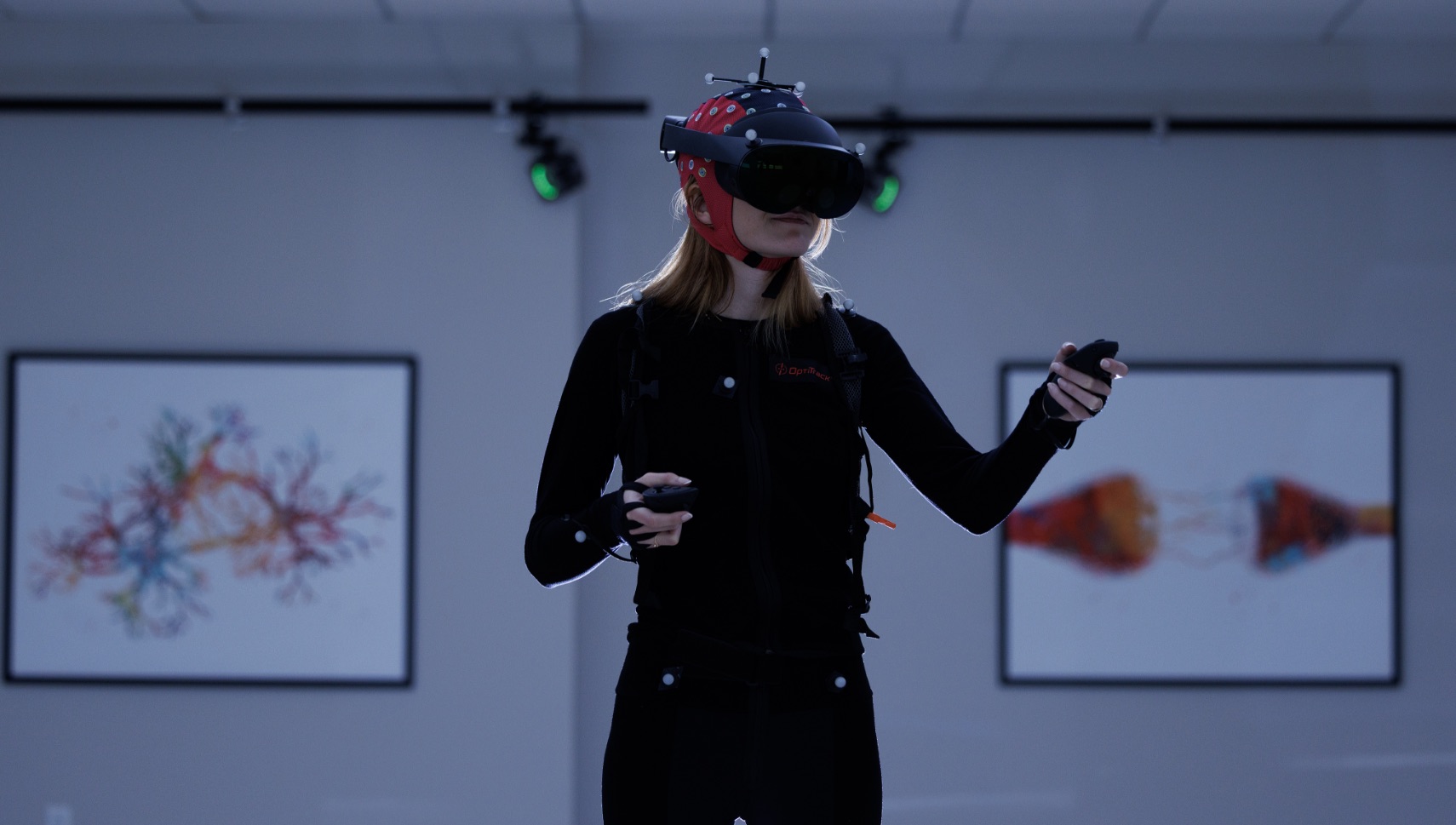
Most neuroscience research asks people to sit still. Our NeuroMotion Lab does the opposite.
We work with participants who have electrodes implanted in their brains for clinical purposes, and, with their consent, we combine those recordings with a suite of wearable and environmental sensors to capture full-body motion, eye tracking, scalp EEG, and physiological monitoring while people explore immersive virtual and augmented reality environments. The result is a system that lets us study brain activity while people walk, explore, make decisions, and interact with their surroundings.
The NeuroMotion Lab enables a kind of neuroscience that wasn’t possible until recently. Instead of inferring how the brain navigates the world from data collected in a scanner, we can observe it directly, in real time, as a person moves through space. We use this to investigate questions about spatial memory, threat detection, social cognition, and the neural dynamics of freely moving behavior.
If you would like to know more about our research, please get in touch.

.png)
See It in Action
See how Nanthia Suthana uses virtual reality to study memory and develop treatments for memory loss.
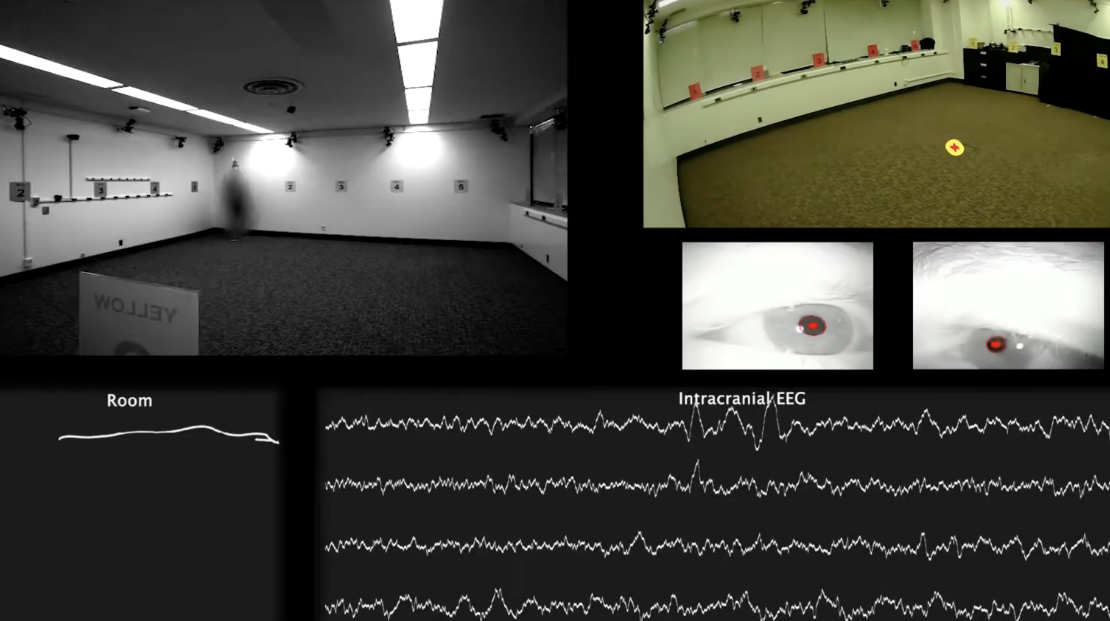
NeuroMotion Platform (Topalovic, 2020, Neuron)
A walkthrough of our mobile deep brain recording and stimulation system in action, showing how we record brain activity during free movement.
.png)
Boundary-anchored neural mechanisms of self & other (Stangl, 2021, Nature)
Investigating how the brain tracks spatial boundaries, both when navigating on foot and when observing someone else.
What’s in the Lab
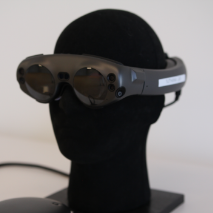
Virtual/Augmented Reality Headsets
A range of wired and wireless VR/AR headsets with 360-degree room-scale tracking. These create the immersive environments our participants navigate while we record their brain activity and behavior.
.png)
Mobile Scalp EEG System
A high-density, 64-channel EEG system with a lightweight amplifier designed for ambulatory recordings, allowing us to measure brain activity while participants walk, navigate, or interact naturally with their environment.
.png)
Infrared Cameras and Optical Motion Tracking
Ceiling-mounted infrared cameras detect reflective markers placed on the body or a full-body suit, allowing us to capture participants’ movements with submillimeter accuracy. This provides a precise, continuous record of how people move through space during tasks.
.png)
Implanted Brain Recording and Stimulation Devices
Implantable neurostimulation systems that allow us to both record and stimulate brain activity. This includes responsive neurostimulation (RNS) systems and deep brain stimulation devices such as the Percept system, which can record neural activity directly from implanted electrodes while delivering therapeutic stimulation.

Wearable IMU Motion Capture Sensors
Lightweight on-body sensors that use inertial measurement units (IMUs) to track body movement without cameras. These systems allow us to measure posture, gait, and full-body motion both inside and outside the lab, enabling motion tracking in natural environments.

Single-Neuron Recording Systems (Ripple and Blackrock)
Neural recording platforms that allow us to capture activity from individual neurons in human participants during cognitive tasks, providing rare insight into the neural code underlying memory, emotion, and decision-making.
.png)
Physiology Measurements
Portable sensors that measure physiological signals like heart rate, skin conductance, respiration, and muscle activity during tasks. These measurements allow us to link brain activity with emotional and bodily responses.
.png)
Neuro-Stack Wearable Neural Interface
Advanced wearable neural recording platform that allows us to capture and modulate activity from individual neurons in human participants during ambulatory cognitive tasks, providing rare insight into the neural code underlying naturalistic memory, emotion, and decision-making processes.
Funded by
.png)

.png)


.png)