Latest News
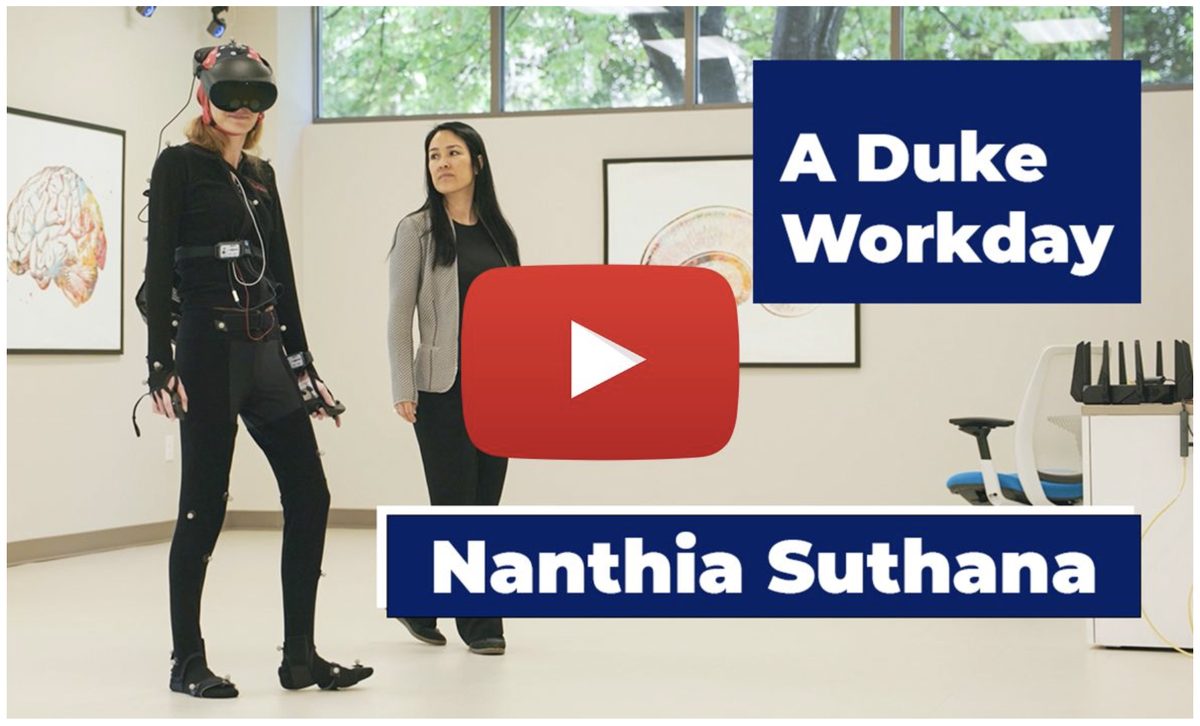
A Duke Workday: How Nanthia Suthana is unlocking the mysteries of memory and the brain

Nanthia Suthana named Carol Gram Deane Presidential Distinguished Professor in Neurosurgery
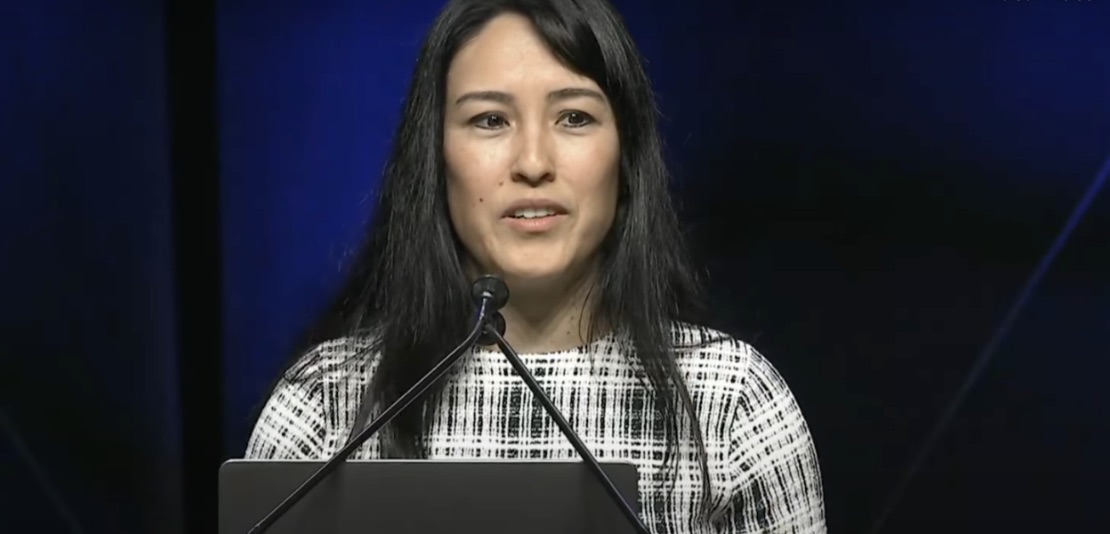
SfN special lecture: From Foraging to Flashbacks — The Neural Basis of Spatial Memory and Mental Time Travel
A Duke Workday: How Nanthia Suthana is unlocking the mysteries of memory and the brain
Duke Today's "A Duke Workday" video series follows Nanthia Suthana through a day in the lab, where her team uses wearable technology to record brain and body activity as people move and behave naturally, with the goal of understanding memory in the real world and improving the lives of patients.
Nanthia Suthana named Carol Gram Deane Presidential Distinguished Professor in Neurosurgery
Nanthia Suthana, PhD, has been named the Carol Gram Deane Presidential Distinguished Professor in Neurosurgery by the Duke University Board of Trustees, one of 38 Duke faculty members awarded distinguished professorships this year. The professorship recognizes her work on the neural mechanisms of memory and emotion, which combines intracranial recordings with non-invasive wearable measurements to improve treatments for neurological and psychiatric disorders.
SfN special lecture: From Foraging to Flashbacks — The Neural Basis of Spatial Memory and Mental Time Travel
From Foraging to Flashbacks: The Neural Basis of Spatial Memory and Mental Time Travel
Special lecture given by Nanthia Suthana, PhD, during the 2025 SfN annual meeting in San Diego, California.
The Suthana Lab at Society for Neuroscience (SfN) meeting
The Suthana Lab team will be attending the Society for Neuroscience (SfN) conference in San Diego from November 15–19, 2025. Nanthia Suthana, along with our lab members and collaborators from the labs of Matthias Stangl, Cory Inman, and the EMBER Archive, will be giving talks and presenting posters showcasing our latest findings. Be sure to stop by to learn more about our cutting-edge research!
Transforming Reality: How Gaming Gear is Impacting Health Care
Several interdisciplinary projects are using virtual and augmented reality to push the frontiers of physical and mental therapies at Duke University. Dr. Nanthia Suthana’s lab works with students of game design, electrical and biomedical engineering, neuroscience, psychology, and even visual arts – presenting powerful opportunities to gain a glimpse into the workings of the brain.
Learning the Language of the Brain
Dr. Nanthia Suthana, who joined the Duke Department of Neurosurgery earlier this year as a Duke Science and Technology Scholar, studies the neural mechanisms of cognition and behavior. At Duke, she is continuing the cutting-edge research she began at UCLA, using advanced neuroimaging and electrophysiology technologies to investigate and treat neurological and psychiatric disorders.
Suthana Lab joins Duke Department of Neurosurgery
Nanthia Suthana, PhD, and her team have joined the Duke Department of Neurosurgery. Suthana specializes in studying the neural mechanisms of cognition and behavior in naturalistic settings. She develops and applies invasive neuroimaging and electrophysiology techniques, including mobile intracranial recordings and deep brain stimulation, to investigate memory, spatial navigation, and neurostimulation-based therapies.
At Duke, Dr. Suthana aims to advance translational neuroengineering and interdisciplinary collaborations to develop novel therapies for neurological and psychiatric disorders.
Kempner Seminar Series – Neural Dynamics of Memory, Navigation, and Threat Detection: Implications for AI and Brain-Inspired Learning Systems
Dr. Suthana was invited to speak at the Kempner’s Seminar Series at Harvard University, February 2025.
This talk explores fundamental neural mechanisms involved in memory formation, spatial navigation, and threat detection, using a unique approach of neural recordings from patients with neural implants who are able to move freely in real-world environments. I will first discuss our research on the human hippocampus and medial temporal lobe, emphasizing how neural activity is dynamically modulated by factors such as movement, spatial boundaries, and social context. These findings provide insights into the flexible, real-time learning and memory processes in the brain, which could inform the development of AI systems that adapt to complex, dynamic environments.
The second part of the talk will focus on threat detection systems in the amygdala, particularly in individuals with PTSD, and how understanding the neural basis of maladaptive responses can guide the development of new therapeutic strategies. These insights also have the potential to inspire AI systems that better model emotional learning and adaptive behavior. Drawing on these findings, I will explore how real-time, naturalistic recordings from freely-moving patients can advance both our understanding of brain function and the development of more robust,
adaptive AI models, as well as improve therapeutic approaches for trauma-related disorders.
Pushing Boundaries: Memory Enhancement, Virtual Reality, and Trauma Therapy in Neuroscience
Dr. Suthana was invited to speak to Andreas Horn who interviews experts in the field of deep brain stimulation, noninvasive neuromodulation, functional brain imaging, and neuroanatomy.
Andreas Horn, M.D., Ph.D., directs the Institute for Network Stimulation and is a professor of computational neurology at the University of Cologne.
Invasive Brain Recordings in Humans, Learning as a PI, and the Joys of Mentorship
Dr. Suthana was interviewed by Benjamin James Kuper-Smith and featured in the BJKS podcast, a podcast about neuroscience, psychology, and anything vaguely related.
Clinical trial for PTSD
Check out the new video on our clinical trial for treatment-refractory PTSD. Hear from a patient in the trial now in remission, sharing their story. Recruitment is ongoing. Please help spread the word.
Have neuroscientists found a new treatment for PTSD?
JT Parr swung by the lab & we had some fun chatting about the brain. His curiosity led to some interesting questions. Plus, we put him to the test with one of our new mobile VR tasks. Check out the full episode on the YouTube series, “Chad & JT Go Deep”.
Human Neuroscience in the Wild – Suthana Lab presents in the symposium at the annual BRAIN Initiative meeting
Congrats to Jay for successfully defending his thesis
Congrats to Matthias for accepting a tenure-track faculty position at Boston University
Congrats to Sabrina for successfully defending her thesis
Recording Single-Neuron Activity During Walking in Humans
A Wearable Platform for Closed-Loop Stimulation and Recording of Single-Neuron and Local Field Potential Activity in Freely Moving Humans
Matthias Stangl receives the 2022 Scheibel Distinguished Postdoc Award
Matthias Stangl receives K99 grant
Congrats to postdoc Matthias Stangl for receiving the Notice of Award for an NIH sponsored K99/R00 grant!
Semel Faculty Spotlight – Dr. Nanthia Suthana
Probing the Untethered Brain
Measuring learning and memory on the go
Studying memory using VR
Nanthia Suthana is the Associate Director of the Neuromodulation Division at the Semel Institute for Neuroscience & Human Behavior. She sat down to talk about her research using permanent brain implants to study learning and memory in humans, her uncharted journey into the brain sciences field and why she is so passionate about outreach. Interview by Berly McCoy.
Could you tell me about your research and how it began?
In 2013, the FDA had just approved a new permanently-placed brain implant device that treats patients with epilepsy. It records seizure activity and then uses electrical stimulation to prevent a seizure from spreading, such that the person hopefully doesn’t notice that they were about to have a seizure.
When I saw that, I thought, “Oh my gosh, this device is going to be implanted in thousands of people to record a brain region that I’ve been studying for 10-plus years in freely behaving humans.” The majority of the research on this topic was done in freely behaving rodents and we didn’t know whether the results would translate to humans. I realized this was an opportunity to bridge that gap.
The first basic question my lab is asking is “What is the role of these brain regions in learning and memory in freely moving humans,” and “Is it similar to what we see in maze memory studies in rats and mice?” And when we don’t see similar effects, “What are the variables that are causing these differences?”
To investigate this, we outfit participants who have implanted sensors with motion capture equipment that can track their eye movement, position, speed, heart rate, blood pressure, respiration, skin conductance and pupil size changes. You name it, we can track it. We simulate real world experiences using virtual reality and augmented reality to understand how these activities modulate brain activity in the regions related to learning and memory.
One thing we’ve found is that eye movements modulate these brain activity patterns when someone is completing a task, which makes sense because we’re a visual species. Another thing we’ve found is that these brain regions are modulated differently by the type of task an individual is performing. For example, if someone is walking to a particular visible landmark or location versus trying to remember where they put their keys, those are two very different tasks. One is a very explicit memory question and one is not. When we compared the two types of tasks, we noticed different brain activity patterns.
Another big finding is that these patterns of activity that are modulated by task or by memory are also modulated by someone’s proximity to boundaries such as a wall. When a person is looking for objects in space, boundaries become very relevant for anchoring them in that space. But they’re also modulated by someone else’s position. That was a very important discovery because that’s something that can’t be done in humans with conventional neuroimaging approaches.
This work is the beginning of a very long puzzle in understanding how this brain system tracks our position as we maneuver through space. There are so many things that are modulating these activity patterns and we are taking the first steps toward understanding what this brain system does in freely-moving humans.
Another part of my lab uses the implanted device for stimulation to test potential new treatments. We have a clinical trial involving combat veterans with very severe, intractable post-traumatic stress disorder. We use this device in a similar way to the epilepsy patients, but instead of using electrical stimulation to prevent seizures, we’re using it to suppress the negative symptoms related to problematic, traumatic memories.
How did you get interested in your field?
Halfway through my undergraduate degree I decided to withdraw. I took a year off, but I didn’t plan to come back. I was undeclared and very much so undeclared in the sense that I had no idea what I wanted to do. I was very lost and that’s partly why I dropped out of school and decided to travel.
I backpacked through Europe and stayed in hostels for several months. I pursued my artistic passions and started reading for fun. I specifically remember reading about Henry Molaison, or H.M., a man who had portions of his medial temporal lobe surgically removed to control his epilepsy, which resulted in an inability to form new memories. It was very shocking to me and I just wanted to understand why. I wanted to know how people learn so differently and how they have different memory capabilities.
I hadn’t learned anything about the brain in high school or in college. It just wasn’t taught in the curriculum in those days. I became really fascinated with this whole new field that I had no idea about so I started going to the library and reading about it. That’s when I realized I wanted to learn more and go back to school.
Can you talk about your educational journey?
I re-enrolled at UC Berkeley and then transferred to UCLA because I wanted to pursue a major in neuroscience, which Berkeley didn’t have at the time. I took every neuroscience class that existed at UCLA. I was totally in love with all the classes.
I graduated in 2005 and started a PhD program at UCLA the same year studying learning and memory with Susan Bookheimer and Barbara Knowlton. My dissertation focused on using neuroimaging to understand the same brain structure that H.M. had removed, the hippocampus, and its role in learning and memory, particularly in spatial memory.
In 2009 I finished my PhD and started a postdoc with Itzhak Fried in the Department of Neurosurgery. I continued to focus on the same topic of episodic memory, as well as spatial memory.
Once I finished my postdoc I stayed at UCLA for a one-year position as a lecturer teaching undergraduate courses. I started applying for faculty jobs, received some offers and ultimately accepted one from UCLA.
What do you hope will be the impact of your research?
A lot of the functions we study are tasks that people with Alzheimer’s disease can’t perform. When we understand how it works, then we can start to think about how we can develop treatments for when things go wrong and ask, “Can we push the system into a more normal state using stimulation?”
We can now test out these new therapies in a realistic, ecologically valid environment that will hopefully better translate to their real world. It has relevance for memory disorders, like Alzheimer’s disease, epilepsy, memory impairments and traumatic brain injuries. We’re ultimately interested in understanding the system such that we can improve the system. For PTSD, we’re interested in doing the opposite, which is suppressing problematic memories that can’t be forgotten.
I hope that these studies will contribute to our knowledge of how these brain areas work and ultimately lead to our ability to develop better treatments for when things are not working appropriately.
On the technology side, the platform that we’ve created is really the first of its kind. We’re hoping that it will enable other people to do similar studies.
What activities are you involved in outside of your research?
I direct a training program in translational neurotechnology, which is focused on developing new technologies that can treat neurological and psychiatric disorders. We have trainees in neuroscience, bioengineering, electrical engineering and physics. It’s a very interdisciplinary program aimed at educating folks to take new technologies from bench to bedside.
I’ve done outreach for as long as I can remember. I’m the director of neuroscience outreach for the Brain Research Institute. We organize Brain Awareness Week and the Brain Bee, which is a neuroscience competition for high school students. I spent two days a week for a year in a high school teaching neuroscience to students through an NSF program. I helped develop a course at UCLA called Project Brainstorm to teach undergrads how to communicate neuroscience to K-12 students, which happens every winter and spring.
Outreach is a passion of mine because I never learned about the brain before I was 19 years old. I felt like that was a problem. So a lot of my outreach is to help educate this younger community earlier about the brain and how it works and get them excited about science. I was not excited about science before I left school and that’s also a problem in terms of how we educate the sciences. The other reason I focus on outreach is of course under-representation in the neuroscience community and STEM more broadly.
What else would you like to share about your identity?
I come from a mixed, underrepresented background. I’m multicultural. I think a lot of that contributes to my identity and who I hope the community will better represent. I think that folks like myself have not been well-represented, especially in the engineering side. I’ve often been the only woman in the room, so to speak, and that needs to change. It’s led to a lot of imposter syndrome and inhibited anger that it is that way. I have a lot of frustration in terms of comments and treatment that comes with being an underrepresented person. That frustration contributes to me hoping to change that room and make it more balanced so that future young women or minorities don’t have to experience these kinds of uncomfortable feelings that ultimately make it harder for them to progress and to do good work, and is sometimes a source of more stress than the first job.
It’s unfortunate because you don’t want to take away from the first (research) because of the second (outreach), but you also realize that no one else is going to do it if you don’t. So it’s a very interesting, constant struggle and a balance to maintain, because they are both important. But it is very challenging.
Read more about Dr. Suthana’s work: Wireless Programmable Recording and Stimulation of Deep Brain Activity in Freely Moving Humans or visit her website.
Jay Gill receives F31/NRSA grant
Congrats to Jay Gill for just receiving the Notice of Award for an NRSA F31 fellowship, with a score of 12 (1st percentile)!
Jay Gill accepted into the SfN Neuroscience Scholar Program
Jay Gill (PhD2, MSTP student) was just accepted into the SfN Neuroscience Scholar Program AND advanced to candidacy all in the same week. Congratulations, Jay!
More about the SfN Neuroscience Scholar Program here.
Best Data Blitz Award goes to… Sabrina Levy!
Congratulations to MSTP student Sabrina Levy who won the best data blitz Award during the UCLA CENT 2021 Online Symposium!
Sabrina also recently advanced to PhD candidacy. Lots of reasons to celebrate!
The Annual UCLA Symposium on Neurotechnology gathers leading-edge scientists, engineers and medical professionals at UCLA to foster understanding and development of neurotechnology, the new frontier in brain science.
Matthias Stangl receives the 2020/2021 UCLA Chancellor’s Award for Postdoctoral Research
Dr. Matthias Stangl was awarded the 2020/2021 UCLA Chancellor’s Award for exceptional Postdoctoral Research.
Read more about Matthias and his research on his featured profile on the Semel Institute website here.
Stories of WiN interview with Nanthia Suthana
Women in Neuroscience (WiN) highlights the stories of female neuroscientists at different career stages and from diverse backgrounds and subfields. Each scientist’s profile featured on this site is written based on an in-depth interview with curated questions underscoring her academic achievements and sources of motivation, as well as some of the challenges on her journey.
Nanthia Suthana chairs session and speaks at SfN Connectome
Scientific Panel
Monday, January 11, 2021
2:15–3:30 p.m. EST
Neural Computations in the Human Brain
Chair: Nanthia Suthana, PhD
University of California, Los Angeles
Presenter: Edward Chang, MD
University of California, San Francisco
Presenter: Jennifer Collinger, PhD
University of Pittsburgh
Presenter: Ziv Williams, MD
Massachusetts General Hospital
Research studies using rare recordings from the brains of patients with implanted electrodes provide a unique opportunity to investigate underlying neural mechanisms of human behavior and cognition. This scientific session will bring together four experts to present their recent findings on a diverse set of topics (language, movement, decision making, memory, and spatial navigation) from intracranial neurophysiological recordings in humans.
NIH media coverage: “Scientists Discover How Our Brains Track Where We and Others Go”
For the first time, scientists have recorded how our brains navigate physical space and keep track of others’ location. Researchers used a special backpack to wirelessly monitor the brain waves of epilepsy patients as each one walked around an empty room hunting for a hidden, two-foot spot. In an article published in Nature, the scientists report that the waves flowed in a distinct pattern suggesting that each individual’s brain had mapped out the walls and other boundaries. Interestingly, each participant’s brain waves flowed in a similar manner when they sat in the corner of the room and watched someone else walk around, suggesting these waves were also used to track other people’s movements. The study was part of the NIH’s Brain Research through Advancing Innovative Neurotechnologies® (BRAIN) Initiative.
Nature News and Views article written by Hugo Spiers summarizing our recent study
Oscillations in neuronal activity in the medial temporal lobe of the human brain encode proximity to boundaries such as walls, both when navigating while walking and when watching another person do so.
Jay Gill receives SfN Trainee Professional Development Award
Jay Gill (PhD2, MSTP student) recently received a Society for Neuroscience Trainee Professional Development Award! Congratulations!
The Trainee Professional Development Award (TPDA) recognizes undergraduate and graduate students and postdoctoral fellows who demonstrate scientific merit and excellence in research.
Sabrina Levy receives NIH F30 grant
Congratulations to MSTP student Sabrina Levy, who was just awarded an NRSA F30 predoctoral fellowship for MD/PhD students with a score of 16 (3rd percentile) on her first submission!
NRSA F30 fellowships support promising predoctoral students in combined MD/PhD and other dual-degree training programs, providing research training within the broad scope of biomedical, behavioral, or clinical research.
Science magazine covers our recent Mo-DBRS platform
Call it neuroscience on the go. Scientists have developed a backpack that tracks and stimulates brain activity as people go about their daily lives. The advance could allow researchers to get a sense of how the brain works outside of a laboratory—and how to monitor diseases such as Parkinson’s and post-traumatic stress disorder in real-world settings.
U Magazine highlights Nanthia Suthana in “Virtual Traveler”
When Nanthia Suthana, PhD ’09 (FEL ’12), was an undergrad at UCLA, she took a year off from school to travel through Europe and try to make sense of the rest of her life. “There I was, a 19-year-old well out of her comfort zone and in a new and strange cultural world,” she says. “As I traveled to other countries, the language barrier added to a profound sense of dislocation. I can still vividly picture myself getting off of a plane and walking around the streets of each new city, trying to remember where I am and figure out where I’m going.”
Nature video featuring work by the Suthana Lab
Virtual-reality technology is being used to decode the inner workings of the human brain. By tasking people and rodents with solving puzzles inside virtual spaces, neuroscientists hope to learn how the brain navigates the environment and remembers spatial information. In this documentary, Shamini Bundell visits three neuroscience labs that are using virtual-reality technology to explore the brain. She uncovers the many benefits — and unsolved challenges — of performing experiments in virtual worlds.
The Suthana Lab is awarded the McKnight Technological Innovations in Neuroscience Award
The McKnight Endowment Fund for Neuroscience (MEFN) announced the three recipients of $600,000 in grant funding through the 2019 MEFN Technology Awards, recognizing these projects for their ability to fundamentally change the way neuroscience research is conducted. Each of the projects will receive a total of $200,000 over the next two years, advancing the development of these groundbreaking technologies used to map, monitor and model brain function.
Nanthia Suthana joins Jonathan Van Ness on the “Getting Curious” podcast
Dr. Nanthia Suthana is a neuroscientist from UCLA who joins Jonathan to discuss memories, how the brain works, epilepsy, new breakthroughs in medical technologies, how virtual reality is used in therapy, and more.
Mashable showcases Nanthia Suthana on an episode of “How She Works”
With neuroscience, inspiration struck Nanthia Suthana at the age of 19. She read about a famous case in which a man underwent brain surgery that robbed him of the ability to form new memories, and she sprung into action.
Now, Dr. Suthana is a neuroscientist at the David Geffen School of Medicine at UCLA, and uses VR to study the brain and understand what happens when new memories are formed.
On this episode of How She Works, Dr. Nanthia Suthana shows us what it’s like working in this field and how she’s using virtual reality to ultimately understand the brain.